Wednesday, 30 November 2016

LED Flasher Using BJT

LED Flasher
LED flasher circuit

The circuit is an astable multivibrator with LED connected to the collector of each of the transistor. The LEDs light up alternately at a frequency predetermined by the value of R2, R3, C1 and C2 using formula for frequency of oscillation of an astable using bjt.
formula for calculating frequency of oscillation in astable multivibrator using bjt

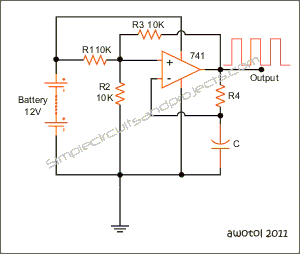
Astable Multivibration Circuit Using LM741

Astable multivibration circuit using LM741

The frequency of this astable miltivibrator circuit depends on all the external components connected to the op-amp. The best practice is to fixed the value of some of the components in order to derived a relation for the frequency. Deriving relation for the frequency is simple if R1, R2 and R3 are fixed with equal value. That is R1 = R2 = R3 = R.

In an ideal situation, it can be shown that the frequency, f of the oscillation is
the frequency, f of the oscillation of astable using comparator
Just like Schmitt trigger that has VT+ and VT-, non-inverting input of the op-amp is either 2/3 or 1/3 of the supplied voltage so that the capacitor, C charges and discharges in between these voltages.

How were 2/3Vcc and 1/3Vcc arrived at?
The figures below will be used to compute the voltages at the non-inverting input of the op-amp, i.e positive and negative going threshold voltage of the circuit between which capacitor charges and discharges. (A) occurs when the output of the op-amp is 'high' while (B) is when the output is 'low'
astable-741 illustration of non inverting input
The figures below show the equivalent circuits of the above figure after applying circuit theorems (equivalent resistance and voltage divider).
astable-741 illustration of non inverting input
Using the formula that was derived for frequency of an astable multivibrator using Schmitt trigger with VT+ and VT- being replaced with 2Vcc/3 and Vcc/3 respectively.
frequency of oscillation in schmitt trigger astable
Click here for astable (comparator) calculator

Astable Multivibrator Circuit Using Schmitt Trigger Inverter

Astable using schmitt trigger inverter
There are many schmitt trigger inverter ICs in the market, some of which include: F40106B, SN7414, CD4010,...Frequency of this astable multivibrator depends not only on capacitor, C and resistor, R but also on the positive-going threshold voltage(VT+) and negative-going threshold voltage(VT-) of whichever ICs one uses. The capacitor, C charges and discharges in between VT+ and VT-.  Deriving a relation or formula for calculating the frequency is done in terms of R, C, Vcc and VT+ & VT- characteristics of the IC. The frequency can be worked out with the formula defining voltage across the capacitor at any given time in a series R-C circuit. Below is the formula.
Equation for voltage across capacitor at time, t in a series R-C
Where Vc(t) is the voltage of the capacitor at a given time, t and it is taken as VT+; Vi is the initial voltage of the capacitor before charging and it is taken as VT-; Vf is the voltage of the capacitor at infinite time which is always Vcc and 0 when charging and discharging respectively, here it taken as Vcc. t is the time taken for the capacitor to charge up to VT+ from VT- or discharge to VT- from VT+; R is the resistance in ohm and C is the capacitor in farad. Therefore above equation now becomes
expression to calculate frequency of oscillation in schmitt trigger astable
Performing arithmetic manipulation
expression to calculate period of oscillation in schmitt trigger astable
Remember that the period of the oscillation, T is 2t and the frequency is the inverse of T. Therefore
expression to calculate frequency of oscillation in schmitt trigger astable
Click here for astable (schmitt trgger) calculator

Monostable Multivibrator Circuit Using 555 timer

monoastable multivibrator using 555 timer
In this circiut, the pulse will be delayed for the time that will take the capacitor, C1 to charge up via R1 to 2Vcc/3 from zero voltage before returning to its stable state.

From equation of voltage across the capacitor at any given time, t in a series R-C circuit
Equation for voltage across capacitor at time, t in a series R-C
Where Vc(t) is the voltage of the capacitor at a given time, t; Vi is the initial voltage of the capacitor before charging or discharging; Vf is the voltage of the capacitor at infinite time which is always Vcc or 0 when charging or discharging respectively; t is the time taken for the capacitor to charge up or discharge to Vc(t); R is the resistance in ohm and C is the capacitor in farad.
delaying period in monostable multivibrator using 555
Therefore the pulse will be delayed for time,
delaying period in monostable multivibrator using 555
Click here for monostable (555) calculator

Astable Multivibrator Circuit Using 555 timer

astable multivibrator using 555 timer
Astable multivibration circuit using 555 timer
Operation of this circuit base on charging and discharging of a capacitor via a resistor. To understand how this circuit operates and derivation of formula or equation for its frequency, one needs to know internal circuitry of 555 timer. Equation for determining voltage across the capacitor at any given time, t in a series R-C circuit will be used
Equation for voltage across capacitor at time, t in a series R-C
Where Vc(t) is the voltage of the capacitor at a given time, t; Vi is the initial voltage of the capacitor before charging or discharging; Vf is the voltage of the capacitor at infinite time which is always Vcc or 0 when charging or discharging respectively; t is the time taken for the capacitor to charge up or discharge to Vc(t); R is the resistance in ohm and C is the capacitor in farad.
Equation for time, t to charge capacitor to certain volt from initial volt in a series R-C
During the charging period, t1, the capacitor, C1 charges through R1 and R2 from Vcc/3 to 2Vcc/3
equation for charging time in 555 astable multivibrator
During the discharging period, t2, the capacitor discharges through only R2 from 2Vcc/3 to Vcc/3 to give
equation for discharging time in 555 astable multivibrator
Period, T of the oscillation is t1 + t2 which gives
period of oscillation in 555 astable multivibration
Therefore, the frequency of the oscillation is
frequency of oscillation in 555 astable multivibrationClick here for astable (555) calculator
Click here for astable (555) calculator

Tuesday, 29 November 2016

Multivibrator

Multivibrators are two-state (high or low) output circuits. These include oscillators, timers and flip-flops. Multivibrators are mostly used in applications which involve timing, pulse generation or pulse triggering of other device and so on. There are three types of multivibrators, these are monostable, bistable and astable.

Monostable
'mono' means one or single, therefore monostable multivibrator is a single-stable state multivibrator with other state unstable or transient. A triggering signal/pulse is needed for this circuit to change to its unstable state which last for a fixed period preset by timer components of the circuit before returning to its stable state. This circuit finds application in a system where a timing period of fixed duration is needed in response to external event.
Monostable multivibrator circuit

Above is a BJT collector-cross-coupled monostable multivibrator circuit. At the instance of power up, the base of transistor T2 is connected to supplied voltage via the biasing resistor, R2 hence T2 is 'ON' and it conducts. T2 connects the base of T1 to the ground via resistor, R3, turning T1 'OFF'. This is the 'Stable State' with zero output.

If momentary switch, SW is pressed, a short circuit is applied between the collector of T1 and the ground forcing capacitor, C to discharge quickly with base voltage of T2 drop below zero volt, T2 goes 'OFF'. With T2 'OFF', base of T1 is connected to the supplied voltage via R4 and R3, hence T1 is 'ON'. The circuit remains in this state for a period determined by the value of capacitor, C and resistor, R2. This is the 'Unstable State'. As C begins to charge up, base voltage of T2 increases and turns 'ON' immediately it is above 0.7V. The duration of the pulse is given by the formula.
formula for calculating delay time for pulse in monostable multivibrator using bjt
Click here for the monostable calculator

Bistable

'bi' means two, therefore bistable multivibrator is a two-stable state multivibrator. That is, on receiving of an external signal (triggering signal/pulse), the circuit changes its present stable state to other and remains in this state until next external signal is received. This circuit can be used as an alternate on/off circuit. In fact in my article 'alternate on/off circuit', alternate on/off circuit is called bistable multivibrator and that is it.

Bistable multivibrator circuitBistable multivibrator circuit
Bistable multivibrator circuit

Above is a BJT collector-cross-coupled bistable multivibrator circuit This circuit choose either of the states at the instance of power up. Assuming T1 is on at the instance of power up, its collector is at ground voltage, hence base of T2. As a result of this, T2 is 'OFF' connecting base of T1 to the supplied voltage via R4 and R3. This state is the set state as the output is high. The circuit will remain in this state unless reset switch is pressed.

Pressing the reset switch connects the base of T1 to the ground forcing it to go 'OFF'. At this stage, base of T2 is connected to the supplied voltage via R1 and R2 which turns T2 'ON'. Also the circuit remains in this state until the set switch is pressed.

Astable
This multivibrator has no stable state -it continually flips from one state to the other without any external signal being applied. It is an oscillator in the sense that it produces a repetitive output signal. Astable multivibrator is an important circuit in any power inverter, it also finds great use or application in generating buzzing sound of different tones by varying the frequency when connected to a speaker. Another good application of an astable multivibrator is in light flasher.

The most common type of astable multivibrator is the cross-coupled transistor switching circuit. This circuit consists of two witching transistors and cross-coupled feedback network of a pair of timer components which allow oscillation between the two states with no external triggering signal. The timer components are the resistor and the capacitor. The period of a complete cycle is given by the equation below.
formula for calculating period of oscillation in astable multivibrator using bjt
Therefore frequency of the oscillation is
formula for calculating frequency of oscillation in astable multivibrator using bjt
Click here for the astable calculator

astable multivibrator circuit
Astable multivibrator circuit


Though the two sides of the circuit are identical, one of the transistors will conduct before the other due some imbalance in the circuit. A transistor will be assumed to have come up first to describe this circuit.

Assume T2 will conduct before T1. At the instance of power up collector of T1 and C1 (volt on the other plate of C1, i.e base of T2 is 0.6V) rises quickly to towards the supplied voltage (Vcc), while base of T1 (C2) rises from initial zero volt towards 0.6V. Immediately the base volt of T1 rises to 0.6V, T1 starts to conduct forcing the base voltage of T2 (C1) to negative voltage which is (-Vcc + 0.6), hence T2 is 'Off'. Collector voltage of T2 rises quickly to Vcc while base voltage of T2 rises gradually in positive direction exponentially with time constant C1R2 towards Vcc. At the instance the base of T2 rises to 0.6V, it starts to conduct forcing the base voltage of T1 (C2) to negative voltage… and the process goes on and on until the supplied voltage is turned off.

Monday, 28 November 2016

Power Inverter Circuit with Low Battery Shutdown 1

inverter circuit diagram
Protection of life of your inverter battery is very important as it is so expensive, even about two times what it cost you to build an inverter. So designing and building an inverter without adequate measure to protect the life of the battery will make one lose greatly. This lead to introduction of a feature called 'low battery shutdown' into my power inverter circuit. This circuit protects your battery from danger of over-discharge. Battery level is measured through the voltage divider circuit of R17, R18 and VR2 which send measured voltage to IC1, a comparator. The voltage is processed by the comparator and output (0 or 1 as the case may be) R20, R21, D1, ZD2 and C5 filter out false signal that may fire the SCR1 to conduction. Once true signal is sent from the comparator, CSR1 conducts and send '1' to pin10 of IC2, SG3524 which disables the pulse generator circuit and the inverter as a whole.

It obvious that battery voltage will jump up when the system is shutdown by 'low battery shutdown' circuit, but the circuit will not honour this false rise in battery voltage as SCR1 continues to conduct and the inverter remains down until reset switch is pressed or you off and on the inverter again through the ON/OFF switch.

Power Inverter Circuit

Your need to read my article on power inverter before you proceed on this page. Having done that, let's go.

power inverter circuit
figure 1, Inverter circuit

Pulse generator circuit
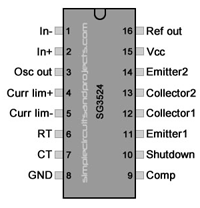
The IC used in the pulse generator (oscillator) circuit is SG3524. This is what Texas Instruments says about the IC "The SG2524 and SG3524 incorporate all the functions required in the construction of a regulating power supply, inverter, or switching regulator on a single chip. They also can be used as the control element for high-power-output applications. The SG2524 and SG3524 were designed for switching regulators of either polarity, transformer-coupled dc-to-dc converters, transformerless voltage doublers, and polarity-converter applications employing fixed-frequency, pulse-width modulation (PWM) techniques. The complementary output allows either single-ended or push-pull application. Each device includes an on-chip regulator, error amplifier, programmable oscillator, pulse-steering flip-flop, two uncommitted pass transistors, a high-gain comparator, and current-limiting and shutdown circuitry".
sg3524
figure 2, SG3524 pin configuration
'Pulse-width modulation (PWM)' and 'shutdown circuitry' are two of the features of this IC that make it my best choice of IC for pulse generator in inverter design. PWM makes the duty cycle achievable while shutdown circuitry makes it easy to shutdown the system in case any error/fault is detected or sensed from any of the protective circuitries like low battery shutdown, high temperature, short circuit, overload or as many as you have in your circuit.The frequency is determined by the value of capacitor Rt and Ct connected to pin6 and pin7 respectively using the formula below.
formula to calculate frequency of oscillation in sg3524
where,
Rt = R9 in my circuit and Ct =C1.
The value of R9 and C1 in the circuit are the ideal values given by calculation, but in real life, you may not get exactly 50Hz. You are advised to replace R9 with 200k resistor and 100k variable resistor. Having done that, you will need an oscilloscope or multimeter with facility for measuring frequency to set your frequency. Connect the probe(s) to either pin11 or pin14 and ground, then increase the variable resistor from zero till your oscilloscope or meter reads 50Hz.

You also need oscilloscope to set your duty cycle. Connect the oscilloscope probe to either pin11 or pin14 andthe ground, vary VR1 and monitor wave-form on your oscilloscope. Alternatively, if you don't have an oscilloscope and you designed and constructed your transformer for modified sine-wave as discussed under transformer design in my article 'power inverter', setting of your duty cycle is easy and done when you have completed the construction. Connect AC voltmeter to the output of your inverter and vary VR1 till the voltage reads 220V.

Circuit description
Power is supplied to the oscillator circuit via IC2, LM7812 (this can be omitted for 12V but include it for 24V) which produces 12V on closing on/off switch. The oscillator generates complementary pulses on pin11 and pin14 which drive power transistors MT1 and MT2. Each of the pins are connected to the ground via 10K resistor so that charges in the MosFet's gate can sink when the pulse is zero. This action causes current to flow through each half of the primary windings of the transformer at alternate halves and alternate current is produced at the secondary winding.

This inverter can deliver up to 1000 watt of power as drain-source current of the MosFets in this circuit is 110A while the effective current that flow in the primary windings of a 1000W transformer designed for modified sine-wave with 80% efficiency is 104A. However, I recommend it for just 500 watt despite the D-S current of the Mosfets. If you want to design it for higher capacity, increase the number of Mosfets and connect them in parallel.

A power inverter is not more than this. Click on inverter with low battery shutdown to see how a low battery shutdown circuitry is introduced to the same inverter. The inverter is the same except for the low battery shutdown; the six MosFets used is just to show you the arrangement when you increase the number of power transistors if the design requires more than two.

Thursday, 10 November 2016

Automatic Street Light Circuit 2

Warning: Please be careful when experimenting or work with this circuit as the circuit contains both AC (mains: 230V) and DC voltage.

This is another automatic street light circuit; the circuit has some advantages over the previous circuit discussed here. Two of the things most if not all design engineers consider when designing are the cost and efficiency, this circuit has the two over the previous circuit. In addition to cost effectiveness and efficiency, it has another feature of being smaller in size as there is no bulky transformer in this circuit.
Automatic Security Light control Circuit 


Automatic Street Light Circuit 

Circuit description

The circuit is similar to dimmer circuit: it has radio interference filter circuit and triggering circuit which includes a x-rated capacitor C2, resistor R1, photocell and diac Q1. In the day, resistance of the photocell is low and the voltage across it is below the break-over voltage of the diac, so the triac can not be triggered at this time. In the night the resistance of the photocell will be at its maximum, and the voltage across it is well above the break-over voltage of the diac. This triggers the triac and current flows with full mains voltage supplied to the lamp.

Automatic Street Light Circuit 1

Warning: Please be careful when experimenting or work with this circuit as the circuit contains both AC (mains: 230V) and DC voltage.

The first time I used this circuit was about seven years ago; then it was given as an assignment in one of my electronic classes during my second year in university. The circuit worked perfectly as designed and I decided to share it with you on this site. The circuit automatically turns street or security light on in the night and off when the day breaks.


Automatic Street Light CircuitAutomatic Street Light Circuit

Circuit description

A step down transformer of 300mA is ok for this circuit. The transformer steps the supply voltage down to 12V and the voltage is rectified by the bridge rectifier (this can be replaced with four 1N4001 diodes) to DC. The filter capacitor C filters out the ripples in the rectified voltage to 15V DC. R1 and photocell form a voltage divider circuit across the DC voltage. In the day according to Jameco's catalogue, the resistance of the photocell is 4K while in the night it is 300K. During the day, the voltage across the photocell is just about 0.58V far below the zener voltage of ZD, hence the transistor T is in off state- just like an opened switch. In the night, resistance of the photocell will be around 300K and the voltage across it is about 11.25V, well above the zener voltage. This turns on the transistor, relay is energized and the normally open contact of the relay is closed to complete the AC circuit; current flows through the bulb and it lights. Resistor R2 is connected in series with the relay coil to limit the current that will flow through it as the DC voltage in this circuit is above 12V which is the rated voltage of the relay. Diode D is connected as shown in the circuit to prevent the transistor from any damage that could arise from induced emf generated as the magnetic flux in the coil collapses when the supply to the relay coil is cut off. The diode is forward biased by the emf and conducts to dissipate the stored energy in the coil.

1 Step Light Dimmer Circuit

Warning: Please be careful when experimenting or working on this circuit as the voltage in the circuit is 230V.

 This circuit is a simple 1 step dimmer. It takes advantage of diodes allowing current to flow only in one direction. Full voltage of 230V is supplied to the lamp when the switch is closed at 'A' as both halves of the supply voltage flow. On the other hand, when the switch is closed at 'B', only positive half will flows to the lamp and this gives voltage of 163V (i.e Vrms/√2 OR Vpeak/2). This reduces the brightness of the lamp.

Diode D1 is T6A100L with rating 1000 PIV and 6A is chosen in this circuit so that it can work with normal 60 watt or 100watt, 115/230V lamp.


I Step dimmer circuit I Step dimmer circuit

Wednesday, 9 November 2016

Light Dimmer Circuit

Warning: Please be careful when experimenting or working on this circuit as the voltage in the circuit is 230V.

Introduction

 On many occasions full illumination is not needed especially at bed time. Instead of turning off the lamp completely with the common switch, dimmer switch gives you power to reduce the illumination to the level you want. Aside that, it adds real beauty to your home and save you energy (money).

The technology of light dimmer is based on adjusting the voltage entering the lamp which in turn varies the brightness of the lamp. In the early days, light dimmer systems make used of autotransformer just exactly what is in the control unit of a ceiling fan, or power resistor to control the voltage that enters the lamp. The problem with them is that they are bulky, expensive and have poor efficiency as they waste much energy inform of heat.

Modern day dimmers make use of solid state switches (triac and diac) to control the voltage entering the lamp. Controlling of voltage entering the lamp is done by chopping out part of the AC wave-form of the supply voltage. This is achievable by varying the triggering angle of the triac as illustrated with the figures below.


Triac triggered at 30 degree


Triac triggered at 90 degree

Circuit Description

The circuit below is a simple dimmer circuit . Network of R1, R2, VR1, C2, C3 and Q1 controls the triggering angle of the triac by varying the variable resistor VR1. Triggering of the triac in the middle of AC phase causes fast rising current surges. This results in radio frequency generation and when triggered at 90 degree it is highest. Network of C1 and L1 forms a simple radio frequency interference filter which filter out the interference.

Dimmer circuit


When VR1 is turned to maximum, the lamp goes off and it is full when VR1 is turned to 'zero'. So varying VR1 from 'zero' to maximum decreases the brightness of the lamp till it goes off.

Monday, 7 November 2016

Battery

 batteries
Battery is an electrochemical cell or a number of electrochemical cells interconnected that convert stored chemical energy into electrical energy. Many home especially those whose their primary source of energy is solar energy intensively depend on it for their energy storage. It is so common and important that there is virtually no home that does not use it for one application or the other- in our cars, laptops, transistor radios, mobile phones, MP3 players, palmtops to mention few all make use of battery.

   
There are two types of batteries: primary batteries (disposable batteries) and secondary batteries (rechargeable batteries)

Primary batteries

Primary batteries are small and mostly used in portable devices that drain low current. They cannot be recharged, since the chemical reactions are not easily reversible and active materials may not return to their original forms. So, when used they will be discarded. Common types include zinc-carbon batteries and alkaline batteries.

Secondary batteries

battery charger Secondary/Rechargeable batteries can be recharged by applying electric current, which reverses the chemical reactions that occur during its use. The needed current to charge the batteries is provided from devices called chargers. Rechargeable batteries come in different shapes and sizes, ranging from a small hearing aid cell to several kilowatt battery bank used as back up for some telecom equipments. The following are some commonly used chemical combination in rechargeable batteries: lead-acid (oldest and commonly use), nickel cadmium (NiCd), nickel metal hydride (NiMH), lithium ion (Li-ion), and lithium ion polymer (Li-ion polymer).
 
rechargeable cell If you have been following me, you would have noticed that my write up is just to give you background knowledge of the subject matter as I am more interested in circuits and projects related to the subject. I will like to draw your attention to rechargeable batteries but we will not discuss its chemistry of charging and discharging here. May be because I do not really like it: while I worked very hard to make a credit in chemistry, I made distinctions in mathematics and physics with no stress.

You know well that batteries are expensive and very useful devices that if not properly used, maintained or/and kept can reduce its lifespan. Deep discharging or overcharging of your rechargeable batteries can cause serious damage to your batteries, so you need to employ means of preventing them from this injury. Here I will present to you different circuits that will help you manage your batteries with no attention of man.