Thursday, 12 January 2017

Over-Under Voltage Block Circuit With Reset

Over-Under Voltage Protector Circuit With Reset

Over-Under Voltage Protector Circuit With Reset

Components:

12V step down transformer
Bridge rectifier diode (DF02M)
Diodes D1, D2, D3, D4= 1N4001
Red LED
6.2V zener diode
Capacitor: C1 = 1000µF, 35V
C2 = 0.01µF ceramic
12V DC relay
Transistor MPS2907A
3 Op-Amp LM741
Momentary switch
Resistors: R1, R5 = 180ohms
R2 = 200K
R3 = 50K
R4 = 47K
R6 = 1K
R7 = 220K
Variable resistor VR1 & VR2 = 200K
Plug
Socket

The circuit is a modification to the previous 'Over-Under Voltage Block' with an additional feature. Circuit description and operation is the same except for that added feature which makes it possible for you to turn on this protection device at will after interruption caused by abnormal (high or low) voltage supply. Just press the reset switch SW and the device will supply your load.

Over-Under Voltage Block Circuit With Delay

Over-Under Voltage Protector Circuit With Delay

over-under voltage protector circuit with delay

Components:

12V step down transformer
Bridge rectifier diode (DF02M)
3 Diodes D1, D2, D3 = 1N4001
Red LED
6.2V zener diode
Capacitor: C1 = 1000µF, 35V
C2 = 100µF, 35V capacitor
12V DC relay
Transistor MPS2907A
3 Op-Amp LM741
Momentary switch
Resistors: R1, R5 = 180ohms
R2 = 200K
R3 = 50K
R4 = 47K
R6 = 1K
R7 = 1M8
R8 = 2K7
R9 = 10K
Variable resistor VR1 & VR2 = 200K
Plug
Socket

The circuit is a modification to the previous 'Over-Under Voltage Block circuit' with an additional feature. Circuit description and operation is the same except for that added feature which delays the time that this protection device comes up (i.e, supply your load) after the interruption. This feature makes this device an ideal one for electrical appliances that use compressor. Such appliances include fridge, freezer, air conditioner etc

Delay is determined by the selected value of capacitor C2 and resistor R7. Average delay time here is about 8 minutes.

Over-Under Voltage Block Circuit

High-Low Voltage Block /Over-Under Voltage Block Circuit

high-low voltage block circuit
Operational Amplifier LM741
Op-Amp 741

Components:

12V step down transformer
Bridge rectifier diode (DF02M)
Diodes D1, D2, D3= 1N4001
Red LED
6.2V zener diode
1000µF, 35V capacitor
12V DC relay
Transistor MPS2907A
2 Op-Amp LM741
Resistors: R1, R5 = 180ohms
R2 = 200K
R3 = 50K
R4 = 47K
R6 = 1K
Variable resistor VR1 & VR2 = 200K
Plug
Socket

The name I gave this circuit was simply base on what it does. Of course, you can call it High-Low Voltage Cut Out or Electronic Fuse (may not be too correct to describe it as the circuit does not blow off) as it protects your expensive electrical appliance or electronics from abnormal(over or under) voltage. The thought for designing this simple circuit came when I lost my CRT television to over voltage. Components used in this circuit are cheap and readily available in market. So, you can build one for to protect your expensive equipment.

The circuit makes use of two comparators, IC1 and IC2. IC1 detects high voltage (say 245V as in this circuit) while IC2 detects low voltage (say 180 volt). Diode D1 and D2 are connected to act like OR gate (they can actually be replaced with logic OR). Zener diode 6.2 volt set a reference for bolt comparators. A variable transformer is needed to set your high and low voltage limit. Plug in your circuit to the transformer and turn your transformer to produce 245 volt. Then turn the potentiometer VR1 such that its value increases and stop at the instance the LED light. In this way, high voltage limit has been set. To set the low voltage limit, turn the transformer to produce 180 volt and vary potentiometer VR2. Stop at the instance LED light.

At voltage above 245 volt, non inverting input of IC1 is at higher potential to inverting input, hence output is high. At voltage below 180 volt, non inverting input of IC2 is at higher potential. The output is also high. In both cases, transistor T (PNP) is not conducting (i.e, block). Reverse is the case in both comparators when supply voltage falls between range 180 – 245 volt.

There is a short coming in this over-under voltage Block circuit, anyway it depends on the application. If the supply quickly jump out of the range and return in few seconds, it means your appliance will respond the same way (off and on) which is not good for most appliances. In other versions of this circuit, I incorporate reset circuit in one and delay circuit in the other.

One with reset circuit allows you to turn up your appliance at will after which it has cut off due to abnormal voltage by simply press the reset switch, SW. Other with delay circuit is good for appliances with compressor e.g fridge, AC etc. it delays the time (predetermine with selected value of capacitor and resistor) it supplies voltage to the appliance after interruption resulting from abnormal voltage.

12Volt Transformerless Power Supply Circuit

Transformerless Power Supply Circuit

Warning: There is no isolation between low and high voltage from wall receptacle in this type of DC power supply, so you have to be very careful when experimenting or work with this circuit.

This power supply is suitable when designing for application that requires low power and where cost and size are of great consideration as expensive and bulky transformer is eliminated in this type power supply.

All the components in this circuit are sized so that the circuit can deliver 12 volt and 30mA of current at the output to the load. The ripples in the voltage from the rectifier is filtered by capacitor C2 while zener diode ZD regulates the voltage to produce 12 volt. The output voltage will remain constant as long as the output current is not more than the input current. The input current is determined by AC voltage input, capacitor C1, resistor R1 and R2. R2 also perform an important task of limiting the inrush current .

Wednesday, 11 January 2017

DC Power Supply

Though power supply circuits are very common in electronic books and on internet yet I found it necessary to discuss it here in the simplest possible way that can easily be understood by new electronic enthusiasm. Power supply of different kind is needed to carry out test on your design or project either bread-boarding or finished work. It can also be used to power some of your household appliances.

There are two types of electrical power. These are alternating current (AC) and direct current (DC). From here I will be referring them as AC and DC accordingly.

Alternating Current (AC)

Pure sinusoidal AC voltage is produced from AC generator called alternator. You may have heard wind powered generator, petrol or diesel generator, gas turbine, thermal turbine or hydro turbine; all these have electrical part which is an alternator. Other part or every other components attached are to drive or cause the alternator to rotate in order to produce electricity (AC voltage). This is called AC because it has both negative and positive halves that alternate at every half cycle.

Direct Current (DC)

On like AC, there are three main sources of DC voltage. These are DC generator (only difference between AC and DC generators is presence slip rings in AC generator and split rings in DC generator), chemical (battery: wet or dry cell) and solar (photovoltaic module). How DC generator, battery or photovoltaic module convert mechanical, chemical or solar energy respectively to electrical energy will not be discussed as it is not within the scope of this topic.

Though I have mentioned three main sources of DC voltage, yet DC voltage can also be derived from AC source with the aid of rectifier circuit. Inside your radio set, CD player, PC power pack there is atleast a rectifier circuit that converts AC voltage from your power outlet to DC voltage; that is the reason you are able to plug them in to AC power outlet.

The process of converting AC voltage to DC is called rectification while the circuit that performs the task is called rectifier circuit. A rectifier circuit could just be a diode/thyristor or network of diodes/thyristors. Aside rectifier, you may also need transformer in your system depending on the voltage level of the AC source and your desired DC voltage.

How diode works

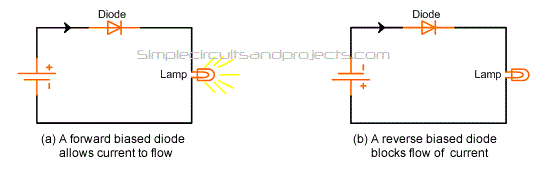
It is very important we look at 'how diode works' before we go to 'how rectifier works'. A diode is an electrical device that allows current to flow in only one direction. See below diode circuits (a) and (b) where diode in circuit (a) is forward biased while diode in circuit (b) is reverse biased. Anode of diode in (a) is at higher potential relative to its cathode and hence allows current to flow. In (b) cathode of the diode is at higher potential relative to its anode, hence it blocks the flow of current. Having understood 'how diode works', let us go to 'how rectifier works'.
diode circuits showing how diodes work

How rectifier works

Half wave rectification

Below is a half wave rectifier circuit which makes up of a single diode for the purpose of rectification. During the positive half cycle, anode of the diode is at higher potential relative to the cathode while cathode is at higher potential relative to anode during the negative half cycle. All positive half waves are permitted while the negative half waves are blocked. This results to the wave shown in the figure below.
half wave rectification circuit

Full wave rectification

Below is a full wave rectifier circuit which makes up of four diodes network for the purpose of rectification.
Full wave rectification
During the positive half cycle, point A of the AC power source is at higher potential hence current flows through diode D2, the load, D3 and back to the source through point B as illustrated with figure (a) below. During the negative half cycle, point B of the source is at higher potential hence current flows through D4, the load, D1 and back to the source through point A as illustrated with figure (b). I want you to note the direction through which current flows to the load in both halves. This shows that the source has been converted to DC as it flows through the load in one direction.
breakdown of full wave bridge rectifier into 2 halves

breakdown of full wave bridge rectifier into 2 halves

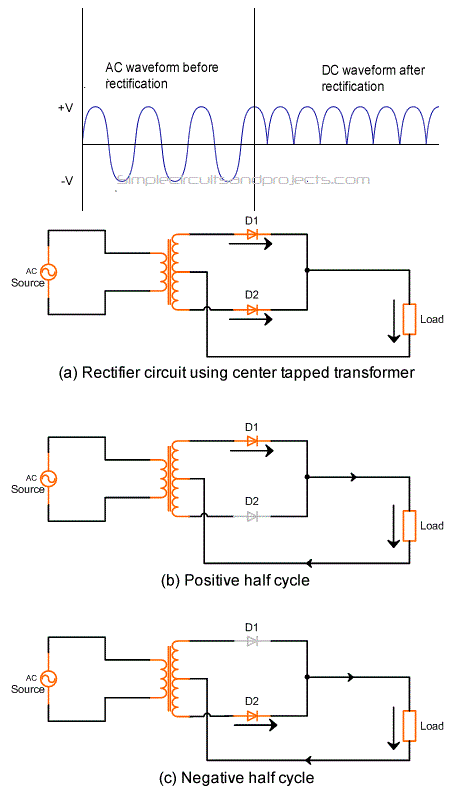
Full wave rectification using center tapped transformer

I believe the following figures should give you the clear picture of how rectification is done in this type of rectification circuit.
full wave rectification using center tapped transformer
Without dwelling too much on rectification, let us quickly look at how to smoothen output of rectifier.

Rectifier with filter capacitor

In the rectifier circuits discussed above, outputs in all the cases are pulsative DC voltage. In almost all applications, smooth and non-pulsative DC is most desired. This leads to introduction of filter capacitor to filter out the pulses. See the figures below for what the wave forms look like after introduction of filter capacitor C.
halfwave rectifier with filter capacitor

fullwave rectifier with filter capacitor
Even with the introduction of the capacitor, undesired element (ripples) which depend on the applied load still exist. To get rid of these ripples, many voltage regulator ICs have been developed so as to have a smooth DC voltage. Some of these ICs are LM317 (variable output voltage), LM7812 (+ve 12V), LM7912 (-ve 12V), LM7806 (+ve 6V) and soon on.