Saturday, 31 December 2016

DC Motor

A motor is an electromechanical device that converts electrical energy into mechanical energy (that is, rotational movement). Its action is based on the principle that when a current-carrying conductor is placed in a magnetic field, it experiences a mechanical force which forced to move in a direction given by fleming's Left-hand Rule (not within the scope of this topic, so let's leave that for now). There are two types of motor: AC motor and DC motor. The major different between AC and DC motor is the presence of slip rings in AC and split rings DC. AC motors operate on AC electrical power supply while DC motors produces rotational movement only on application of DC electrical power. This rotational movement can then be converted to other types of movement like oscillation, linear movement etc using mechanical device(s). These movements are seen when you inject your CD/DVD drive, when you are opening your motor driven gates, robots and so on.

DC motor which is the focus of this topic is similar to DC generator in terms of construction. In fact, a DC machine can be used as motor or generator. DC motor comes in different ratings like 6V, 12V etc. It has two wires or connectors through which it is connected to supply. When connected to power, its shaft rotates. When the polarity is reversed, the direction of rotation of the shaft changes.

Experiment 1
You can try this experiment out yourself to verify the fact that a DC motor can be used as generator: get a small DC motor of either 6V or 12V connect its connectors to your digital voltmeter just as shown in figure below. Now use your hand or try any other possible means to rotate the shaft as fast as you can and observe the meter display. The display reading represents the generated voltage as a result of turning the shaft. The generated voltage is proportional to angular velocity (speed of rotation) of the shaft. One more test before you disconnect your experiment: change the direction of rotation of the shaft (that is, turn it in other direction) and notice the reading on the meter display. Results of the experiments will show negative sign in one and no such negative sign in other. This shows how polarity and shaft direction are related in a DC motor.
DC motor used as generator
Experiment 2
Before you go, connect your DC motor to a battery as shown in the figure below and observe the direction of rotation of the shaft. Now! Change the polarity and also observe the direction of the shaft. The result you see is the evidence how polarity reversal cause the shaft to change direction.
DC motor connected to battery
What I have done is just to let you have basic knowledge of a simple DC motor so that you can under those DC motor related circuits on this site as I am not going to take you through the construction or how the magnetic field cause the shaft to rotate. So we will use electronic circuits control speed and direction of rotation of DC motor.

Alternate on/off circuit

An alternate on/off circuit is basically a bi-stable multivibrator in the sense that it has two stable state (high and low). A slight difference between this circuit and the common bi-stable multivibrator that you might have come across in books is that those one have two triggering points, set and reset. In the case of this circuit, there only one triggering point which is provided with a momentary switch which changes the state (high/low OR on/off) of the output point of the circuit each time the switch is pressed. This circuit allows you to use a momentary switch to turn on and off your electrical or electronic system by momentarily pressing the switch.
alternate on/off circuit
Operation/description
At the instance of power-up, the base of T1 is at ground potential and it is blocked. Base voltage of T2 equals to supply voltage, hence bias it so it conducts. C1 charges up via R3. This circuit will remain in this state if not altered.

If switch SW is momentarily pressed, it causes a change of state in the circuit. Capacitor C1 (which has been charged up to supply voltage) will force T1 to conduct as it releases stored charges to bias it. at this time, T2 with base connected to collector of T1 is at ground potential (note: base and collector of T1 and T2 are cross-connected to each other). The circuit remains in this state till SW is pressed again.

Output
This depends on how you want your system to be (running or stand-by) at the instance of power-up. if desired that the system should start working immediately the power is switched on, the relay driver should be connected to O/P1. If desired on the other hand that the system should be on stand-by when power is switched on until the SW is pressed, connect the relay drive to O/P2.
alternate on/off circuit- stand by

alternate on/off circuit- run
Area of application
Alternate on/off circuit can be used in wide range of application depends on you, how you can apply it. Click DC motor reverse controller circuit to see how it is being used to control dc motor to rotate in both directions. It can also be used in application like remote controlling of electrical or electronic systems if the controlling operation is limited to only switching on and off.

DC Motor Reverse Controller Circuit

DC motor reverse controller circuit

Components:

R1,R6 = 1K
R3,R2,R4 = 100K
R5 = 10K
R7 = 220K
R8,R9,R10,R11 = 18K
C1 = 1µF
Q1,Q2 = BC337
Q3,Q4,Q5,Q6 = MJE800

In this circuit, an alternate on/off circuit is used to control switching of the bridge network of transistors(T3 - T6). DC motor in this circuit changes its direction of rotation each time the momentary switch SW is pressed

The working operation is simple, click here for the operation of alternate on/off circuit that controls the bridge network that drives the motor.

At the instance of power-up, T4 and T5 are forward biased so that current flow through T4 to the motor, then through T5 to the ground. When the switch, SW is pressed, reverse is the case. The base potential of T4 and T5 equals to zero while T3 and T6 are forward biased. Current flows through T3 to the motor and through T6 to the ground. This way, the motor will rotate in both directions; each time SW is pressed, the direction is reversed.

Battery Load Priority Selector Circuit

Battery Load Priority Selector Circuit
The name 'Battery Load Priority Selector Circuit' simply describes what the circuit does. In any electrical system where battery is being used as back-up power in the event of primary power source failure or outage, there is always a need to select priority for the loads as some loads are more important than others. This circuit help to cut off those less important loads from the supply if the battery has discharged to certain preset value so as to reduce energy being taken from it to allow more important loads work for longer period before battery completely discharged or primary power restored.

In this circuit, three level of load priorities are selected: the least important load will be cut off from the supply when the battery is 20% discharged, second set of loads which I called less important load will be cut off when it is 40% discharged. Finally, the important loads (load given highest priority) cut off when the battery is considered 'zero'(i.e, complete discharge) to prevent it from deep discharge. It is your duty to choose which load is important, less or least important according to your need and connect to the load points as shown in my circuit. Feel free to check my Battery Level Monitor and Lead Acid Battery Charger for description of how battery level is sensed by IC4, how IC4 send processed signals to IC1, IC2 and IC3 accordingly and finally produce outputs that energise or de-energise the relays.

Components
IC1 to IC3= NE555
IC4= LM3914
IC5= LM7809
Transistor: T1 to T3= BC337
Resistors: R1= 1K2
R2= 3K9
R3= 10K
R4= 20K
R5 to R14= 100K
R15 to R17= 33K
R18 to R20= 1K
Variable resistors: VR1= 20K
VR2= 50K
LED1 to LED3= red light emitting diode
D1 toD4 = 1N4001
Capacitors: C1= 10µF 35V
C2= 0.1 µF ceramic
Relay1 to Relay3= 12V DC (select contact's current rating according to your load demand)


Lead Acid Battery Charger

Lead-acid battery charger circuit
This Lead Acid Battery Charger is suitable for all types of lead acid batteries. LM3914 and NE555 are used together to perform task that make it independent of human attention. While LM3914 is used to monitor status of the battery during the charging process, NE555 receives reports (signals) from LM3914 and act accordingly.

Circuit description
The operation description is simple once you have the understanding of the connection of main components of NE555 timer. The connection is shown bellow.
555 time IC main components
555 internal connection

Setting of LM3914 circuit for battery level calibration is explained in my Battery Level Monitor Circuit. When the battery is fully charged, pin10 is low and '0' is sent to pin2 of 555. Look at the circuit above, with '0' sent to pin2 which is connected to inverting input of comparator 2, output of the comparator is high, that is, '1'. This set the flip-flop (F/F) and the output of F/F (i.e pin3 of 555) is '1'. '1' is sent to the base of T1 (PNP) and it blocks hence cut off the relay which breaks charging of the battery.

If a fully charged battery is left for some time, it will drain down even if not used. This circuit have provision for that as it charges up the battery whenever it discharges to a preset voltage level. This is how it works, pin13 of LM3914 is high whenever battery voltage drops below that preset value, therefore '1' is sent to pin6 (non-inverting input of comparator 1) of 555. With non-inverting input of higher potential, comparator output is high, '1', this reset the F/F to zero so pin3 of 555 is low, '0'. This turns on T1 and the relay is activated again. At this time, LED 5 lights up indicating that the battery is charging.

LED 1, LED 2, LED 3 and LED 4 are connected for visual display of of the battery status. When no LED is lit, the battery is considered empty. When only LED1 is lit the battery is 10% charged; LED1 & LED2, 30%; LED1 LED2 & LED3, 60% and finally when all LEDs are lit, it is 90% charged.

All the components are sized to deliver current of 20Amp. Nevertheless it should not be loaded with battery that draw more than 15Amp.

Components
LM3914 IC
NE555 IC
Bridge rectifier GBPC25-1
Step down transformer 15V secondary, 450VA
Transistor:T1= MPS2907A, T2=BC337
Resistors: R1= 1K2
R2= 3K9
R3, R6, R7= 10K
R4= 20K
R5= 1K
R8= 4K7
R9 100Ω
R10= 33K
R11, R12, R13, R14, R15, R16= 100K
Variable resistors: VR1= 20K
VR2= 50K
Diode: 2 1N4001
5 LEDs
LM7809
Capacitors: C1= 10µF, C2= 100 µF
Relay 12V DC, 20A contact current

Battery Level Monitor Using LM3914

12V battery level monitor

Components:

LM3914 (Dot/bar display driver)
resisters: R1 = 1K2
R2 = 3K9
R3 = 10K
R4 = 33K
Variable resistor: VR1 = 20K
VR2 = 50K
Capacitor C1 = 10F
Diode D1 = 1N4001
LED1-3 = red LED
LED4-7 = yellow LED
LED8-10 = green LED

Monitoring of your expensive battery level or voltage is important to extend its life span, this simple circuit will help you do that. The major component of the circuit is LM3914 (dot/bar display driver). I came across this IC a few years ago and it caught my attention. I quickly browsed for its data sheet for better understanding of its connections and specifications. It is widely used for this type of application; original circuit on which a slight modification was done was from the data sheet. It is a great IC as I am concerned as it gives me nothing but the expected result. Of course, the IC can do more than monitoring battery level or voltage as it is used and described in this write up. See my 'lead-acid battery charger circuit' for how it is used to do a good job.

You need a digital voltmeter and a variable power supply like the one on this site for final setting of your circuit. To set the upper limit, connect the power supply to the circuit and adjust it to give 13.8V (check manufacturer sheet of your battery). Now, adjust VR1 till all the ten LEDs light up, this is the upper limit. For the lower limit, adjust the supply voltage to give 10V (also check manufacturer sheet of your battery) and adjust VR2 till just LED1 lights.

The circuit is in bar configuration mode. To connect it in dot mode, pin9 will not be connected. You need to be mindful of the polarity as LM3914 is very sensitive to polarity and get damage immediately you connect to wrong polarity. To protect it against wrong polarity, diode D1 is used as you can see in the circuit.

Thursday, 15 December 2016

Solar Electric Power System

Increase in global demand for solar electric system must have been connected with the fact that the energy source is free and pose no threat to the ecosystem.  Photovoltaic (PV) module captures light (solar) energy and converts it directly to electrical energy using solar cells. The generated energy could either be used directly by electrical appliances or stored in form of chemical energy in battery for use later.
You have been provided with the following topics to help you decide and work out system that best suit your home requirement. However, if you don’t have basic knowledge required or not sure of what to do, please invite an engineer to do that for you.


Types of Solar Electric System
Solar electric system can be classified into two major types. They are off-grid systems and grid-tied systems.

Off-grid Systems
They are also called stand-alone systems. Although they are most common in remote locations without utility grid service, off-grid solar-electric systems can work anywhere. These systems operate independently from the grid to provide household’s electricity. That means no electric bills and no blackouts-at least none caused by grid failures. They are generally designed and sized to supply DC and/or AC electrical load. People choose to live off-grid for a different of reasons, including the prohibitive cost of bringing utility lines to remote home sites, the appeal of an independent lifestyle, or the general reliability a solar-electric system provide. Those who choose to live off-grid often need to make adjustments to when and how they use electricity, so they can live within the limitations of the system’s design.

The simplest type is the direct-coupled system, where the DC output of a PV module is directly connected to a DC load. The critical part of designing a well performing direct-coupled system is the matching of impedance of the electrical load to the maximum power output of the PV module. It can be used to operate pumping machine where water is pumped in the day to reservoir for used in the night. The drawbacks in this type of off-grid are:

It can only be used in the day to supply load as there is no battery for storing energy.
It can not be used with AC load
solar electric system: Direct-coupled system
Direct-coupled system

Another type of off-grid system is the type that incorporate inverter unit for conversion of DC voltage to AC at appropriate voltage level. The only drawback of this system is the lack of storage unit, so it will not supply load at night. The block diagram is shown below. 
solar electric system: System with inverter
System with inverter
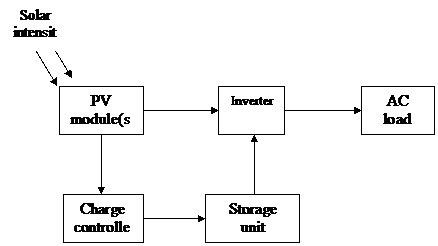
The problem of no electricity generation in the night is eliminated with the inclusion of storage unit (batteries) as backup energy in the night. The block diagrams of this type are shown below.
solar electric system: Off-grid system with battery with no DC output
(a)
solar electric systemOff-grid system with battery with DC output
(b)
Off-grid system with battery (a) with no DC output and (b) with DC output.

Off grid systems can also be sized to provide electricity during cloudy periods when the sun doesn’t shine. Sizing a system to cover a worst-case, like several clouds days can result in a very large expensive system that rarely get used to its capacity. To reduce cost, it is sized moderately, but includes a back-up engine generator to get through occasional sunless stretches. The generator produces AC electricity that a battery charger (either stand-alone or incorporated into the system) converts to DC energy, which is stored in batteries. Below is the block diagram of this type of stand-alone system with generator back-up.
solar electric system: Off-grid system with engine generator as back-up
 Off-grid system with engine generator as back-up.

Grid-tied systems
They are also called on-grid or utility interactive. Grid-tied systems are designed to operate in parallel with and interconnected with the electric utility grid. Below are the block diagrams of grid-tied systems.
solar electric system: Grid-tied system with no battery for storing charges
Grid-tied system with no battery for storing charges.
solar electric system: Grid-tied system with batteries for storing charges
Grid-tied system with batteries for storing charges.

Grid-tied system can also be connected in a way that utility supply will be charging battery in the period of low light intensity. It has the same features as off-grid system with engine generator back-up. In the case of long cloudy days and utility outage, there is likely to be blackout.
solar electric system: Grid-tied system with utility connected to charge battery
 Grid-tied system with utility connected to charge battery.

Components of Solar Electric System

Photovoltaic module

Photovoltaic module consists of solar cells which convert light directly to electricity. When light photons are absorbed by the atomic electrons in the semiconductor material from which the solar cells are made. Each photon absorbed causes an electron to be freed from its atom and drift through the semiconductor material in an electric field created by p-n junction formed just below the surface of the solar cell. The free electrons and the resultant positive changes are collected by metallic contacts applied to the front and back surfaces of the solar cells thereby setting up an electron current which is made to flow through an electrical circuit to deliver power just like a storage battery. The current produce by a solar cell is proportional to its surface area and the light intensity, whereas the voltage is limited by the forward potential drop across the p-n junction.

In order to get higher voltages and currents, the cells are arranged in series and parallel strings and packed into modules for mechanical protection. The support structure for PV modules should be corrosion resistant (galvanized or stainless steel or aluminum) and electrolytically compatible with materials used in the module frame, fasteners, nuts, and bolts. The design of the support structure should allow for proper orientation of the module and tilt.

Charge controller
As PV cell costs continue to fall, the battery in a stand-alone PV system becomes an increasingly large part of the system cost. Battery’s life now has the greatest impact on the economic viability of solar electric system. The controller must manage a rapid, yet safe, recharge under a very diverse range of system conditions. The charge controller in small stand-alone systems is the primary driver of system reliability and battery life. An advanced controller will affect the system performance more than any other component, and an improved controller will on the long run reduce the system’s cost as the battery won’t need to be replaced often.

Battery
The most commonly used battery in solar electric systems is a lead-acid battery of the type used in automobiles, sized to operate for desired hours or days. Automotive batteries are often used because they are relatively inexpensive and readily available. Ideally, solar electric systems should use deep cycle lead-acid batteries that have thicker plates and more electrolyte reserves than automotive batteries and allow for deep discharge without seriously reducing the life of the battery or causing damage. In a well designed solar electric system, such batteries can last for more than ten years

Inverter
An inverter is a basic component of any independent power system that produces AC power. Inverters convert DC power from PV module or stored in batteries into AC power to run conventional appliances. Another application of inverter is in the case of uninterruptible power supply where the inverter with the aid of 12V DC battery is able to generate up to 220V AC that can be used to power most house and office appliances depending of their power rating. While one needs to buy PV module and battery, a hobbyist who likes putting things together may personally love to build an inverter for his solar electric project by himself. Of course I do for personal uses. Why the waste of time and resources when there are cheap and neatly packaged inverters in the market.

Sizing Solar Electric System
Before sizing various components of your solar electric system, you need to find out what your average energy usage is. An engineer can be invited to assess your load in order to determine your peak load. Fielding questions from engineer will help to determine your average energy usage. Alternatively, if your home is already connected to the grid, your monthly electric utility bill will give you your monthly energy usage. Dividing this by the number of days of the month gives you an average daily energy usage. An important area where you will need advice and/or service of an engineer is how to bring the current energy usage of your home down in order to reduce the cost of your solar electric system. There is a lot of energy saving electrical devices being used these days in place of old ones that save you up to 40% or more of energy. In some cases, you may need to replace some of your old appliances with the new ones that consume less energy.
It is also important to estimate various losses associated with your installation. Some of these include losses due to orientation of PV module, shade, dust, temperature effect, name plate mismatch, cable loss, semiconductor loss (in inverter), running power of charge controller etc. A book on solar home system put the estimate of all these to be 50%. I have also seen other literatures on solar electricity that put the estimate between 20% and 30%. Nevertheless the choice is yours. You may want to know what I use in my design. I choose between 25% and 50% depends on who my client is and the project. For instance, semiconductor loss may be of less important in a system meant to power dc load.

Sizing of PV module
The capacity of modules is given in watt-peak. This allows for calculation of electricity generated under different levels of sunshine. To standardize the capacity of solar PV modules, the capacities are given at an illumination at exactly 1000watts per square meter. One watt-peak generate one watt of electricity under the standard test conditions of 1000watts per square meter and temperature of 25oC.
Again, one needs to know the amount of sun that is available. Meteorological tables show the solar insolation (usually in KWh/m2/day). This is different from day to day and shows a seasonal variation over the year. It is safe to design the system based on the average daily insolation in the month with lowest insolation. The easiest way to know the average daily insolation of your area is to search the internet: someone must have published something on that.
Having done that, you can now slot in all the information into the formula below to get the required PV module size in watt-peak (Wp)
solar electric system
Click here for solar calculator

Sizing of battery bank
Batteries are rated in ampere-hour (Ah) and the sizing depends on the household energy consumption.
Due to low voltage disconnect, one does not use the complete battery capacity. Only certain percentage (discharge capacity) of the battery would be used. A deep-cycle battery can be discharged up to 80% (actual value depends critically on the low voltage setting) of its capacity. Now battery is sized with the formula below.
solar electric system

If the system is being designed to power ac load and inverter is needed, one has to put into consideration the inverter efficiency. The formula above can be modified to
solar electric system
Click here for solar calculator

Sizing of Inverter
Inverter should be sized to handle the peak load. It is recommended that the inverter be sized 20% above the peak load.

Installation
mounting of solar panel

Mounting of solar panel

Solar Electric Power or System Sizing Calculator


Parameters definition and description

Daily energy consumption is your calculated energy usage (KWh or Wh) for the day. This parameter is needed for both PV and battery bank sizing.

In addition to daily energy consumption, three other parameters are required to size your PV.


  1. AVERAGE DAILY INSOLATION: one can get this from the metrological table of their area. Click here to view world map showing the average daily insolation.
  2. PERCENTAGE ENERGY LOSS: this is various losses sum up together due to your PV installation. Click here to read more under heading 'Sizing Solar Electric System'
  3. PV RATING: this is the Watt-peak rating of your PV written on the name plate. May why, you should choose PV with voltage correspond to your design. For instance, a system design for 12V system should have nominal of 12V. Of course, peak power voltage will be far above this.

Also, three additional parameters are required to size your battery bank.


  1. BATTERY VOLTAGE: this is the DC voltage of your system (e.g 12V, 24V, 48V…)
  2. DISCHARGE CAPACITY: As explained in the article 'Solar Electric System', under 'sizing of battery bank', one doesn't discharge the battery to 'zero'. This is the percentage of discharge of the battery.
  3. INVERTER EFFICIENCY: The efficiency of your power inverter is written on its name plate. If your system is design for DC load as in solar lamp, solar street lighting system which require no inverter, simply enter 100% in this place or otherwise, the efficiency on the name plate.

Slot in all the parameters above and click on 'calculate' button to generate the results.


Daily energy consumption:
********************************************************************
PV SIZING PARAMETERS
Average daily insolation (in KWh/m2/day):

Percentage energy loss:

PV rating (in Watt-peak or Watt):
********************************************************************
BATTERY SIZING PARAMETERS
Battery voltage:

Discharge capacity (in %):

Inverter efficiency (in %):
********************************************************************

********************************************************************
OUTPUTS
Total PV rating (in Watt-peak or Watt)=

Number of panels =

Battery rating (Ah) =

Tuesday, 13 December 2016

LM317 variable power calculator


LM317 Variable DC Power Supply Circuit
Resistor (R1): Ohm

Variable resistor (VR):
***************************************************

***************************************************
Output voltage(VO)= V


0-35V Variable DC Power Supply

0-35V variable power supply
lm317 pin configurationComponents:
Step-down transformer 30V
Bridge rectifier (DF02M) or 4 1N4003 diodes
2200µF, 50V capacitor
2 1N4002
2 Resistors: 1K & 180ohms
Potentiometer: 5K
LM317
Red LED

In this circuit, I used LM317 (an adjustable voltage regulator IC). The input voltage to the IC is approximately 41V. You can check my 12V regulated DC power supply and Dua DC power supply where I explained in a simple way voltage entering voltage regulator IC with Vrms-Vpeak relationship and diode p-n junction voltage drop. In this circuit, p-n junction voltage concept play a vital role: it will be discussed here.

LM317 provides an internal reference voltage of 1.25 V between the output and adjustments terminals. This is used to set a constant current flow across an external resistor divider giving an output voltage VO of:
lm317 equation

note that 'VO = VREF (1 + R2/R1) + IADJR2' is what you will see in the data sheet. Since I am using it to explain circuit on this page I have to change 'R2' to 'VR' to correspond with the circuit.

The device was designed to minimize the term IADJ (100 µA max) and to maintain it very constant with line and load changes.

VO is 1.25V (the minimum output voltage) when potentiometer VR turned to zero and is 36.47V when VR turned fully to give 5K. In order to get an output voltage of 0V when VR is turned to 'zero' diode D1 and D2 are connected in series to the output as it in the circuit. P-N junction voltage drop of 0.7V of each diode give total of 1.4V which completely remove its minimum output of 1.25V. Also 1.4V is cut from the maximum to get 35.07V.


Dual DC Power Supply

 dual DC power supply
Components:
Center tapped step-down transformer 6V-0-6V
Bridge rectifier (DF02M) or 4 1N4001 diodes
2 2200µF, 25V capacitors
2 100nF ceramic capacitors
2 10µF, 25V capacitors
LM7806
LM7906

In this dual DC power supply, a center tapped transformer of 6V-0-6V is used. With the filter capacitor of 2200µF, the voltage entering the voltage regulator IC, LM7806 and LM7906 is approximately equals to peak voltage of the wave form minus 0.7 which is 7.8V; where 0.7 is the p-n junction voltage drop across the diode. That is

Vpeak - 0.7 = (Vrmsx√2)-0.7

(6x√2)-0.7 = 7.8

If you need dual DC power supply with voltage of 5V & -5V, 8V & -8V, 9V & -9V, 12V & -12V and so on, you will only change your transformer to the one with secondary voltage relative to what you want. Replace your voltage regulators with LM7805 & LM7905, LM7808 & LM7908, LM7809 & Lm7909, LM7812 & LM7912... accordingly. Also note that the capacitor must be replaced with the one that has voltage greater than the peak voltage.

12Volt Regulated DC Power Supply Using LM7812

12V regulated dc power supply circuit

lm7812 pin configurationComponents:

12Volt Step-down transformer
Bridge rectifier (DF02M) or 4 1N4001 diodes
LM7812
2200µF, 35V capacitor
100nF ceramic capacitor
10µF, 35V capacitor

 
In this circuit, transformer with 12V secondary voltage is used. With the filter capacitor of 2200µF, the voltage entering the voltage regulator IC is approximately equals to peak voltage of the wave form minus 1.4; where 1.4 is the p-n junction voltage drop across two diodes as each half cycle passes through two diodes. That is

Vpeak - 1.4 = (Vrms x √2) - 1.4

(12 x √2) - 1.4 = 15.6

hence filtered DC voltage applied to the input of LM7812 is 15.6V.

If you need output voltage of 5V, 6V, 8V, 9V and so on, you will only change your transformer to the one with secondary voltage relative to what you want. Replace your voltage regulators with LM7805, LM7806, LM7808, LM7809... accordingly. Also note that the capacitor must be replaced with the one that has voltage greater than the peak voltage.


Power Inverter

What is Power Inverter?

Power in the topic of this article is used to qualify the inverter so as to differentiate it from a logic inverter. If not otherwise stated, anywhere I write 'inverter' in this article, I mean 'power inverter'. An inverter is a basic component of any independent power system that produces AC power from DC. Inverters convert DC power stored in batteries or from PV module into AC power to run conventional appliances. Another application of inverter is in the case of uninterruptible power supply where the inverter with the aid of 12V DC battery is able to generate up to 110/220VAC (in this article, we shall focus our discussion on 220V, 50Hz AC output) that can be used to power most house and office appliances depending on their power rating.

An inverter consists of the following: pulse generator (or oscillator), gate or base driver circuit (optional), power switch (semiconductor switches) and step-up transformer. The block diagram of an inverter is shown below.

(a)
 

(b)
 

Figure1 Block diagram of inverter


Pulse generator: This is the signal processing and control circuit that generates the logic-level control signals used to turn the power switch (semiconductor switches) ON and OFF. There are many different circuits that one can adopt and use as pulse generator or oscillator, in fact many ICs that need few external components to be connected  are available in the market for use. Such ICs include but not limited to NE555, CD4047, SG3524. The output of this circuit is either sent to the power switch directly the or via the driver circuit for amplification before it is sent to the power switch as the case may be. Of course, the choice depends on the design and/or transistors used as power switch.

Driver circuit: This circuit amplifies the signal from pulse generator to levels required by the power switch and provides electrical isolation when required between the power switch and the logic level signal processing circuit (pulse generator)

Power switch: Semiconductors like power transistors (Bipolar Junction Transistors or Metal-Oxide Semiconductor Field-Effect Transistors) and thyristors are used here as switching devices. They should be sized to withstand the high current of the primary winding (low voltage side) of the transformer.

Transformer: Transformers are of various types: step up, step down, autotransformer etc. They comprise of primary and secondary windings which may or may not be isolated from each other. The windings are electrically interlinked by a common magnetic circuit and operate based on the principle of electromagnetic induction. The number of turns of primary and secondary winding is related to their voltages and currents with the following equations.


transformer formula

transformer formula
Where,
N1        =          Number of turns of the primary
N2        =          Number of turns of the secondary
V1          =          Primary voltage
V2          =          Secondary voltage
I1           =          Primary current
I2         =          Secondary current
 

The size of transformer is proportional to its power. For an ideal (lossless) transformer, the input power equals the output power; but in practice, there is no lossless transformer.

Inverter Output Wave-form

One of the things one has to put into consideration when designing every components of inverter; of course any electrical or electronics system is the out. In the case of inverter, we have to put into consideration output wave-form in terms of peak and RMS values, and power output. For now, let us put power output aside as we shall discuss that later in this article.

In conventional AC power system, the output wave-form is pure sine-wave as shown in figure 2 below. The relationship between the peak and RSM value of pure sine-wave is given by

peak and rms relation
OR
peak and rms relation
Where,
V
P
        =          Peak voltage

V
RMS
   =          RMS or effective voltage

I
P
         =          Peak current

I
RMS
    =          RMS or effective current

RMS is the root mean square or effective value of an alternating current. It is equivalent to steady DC current which gives the same amount of heat when flows through a given circuit for a given time as thus AC.

The above equation was not brought from heaven but a derived equation from the interpretation of RMS ( i.e, square Root of Mean of the Square value) using standard equation of sinusoidal  alternating current (AC),
standard equation of sinusoidal alternating current
 OR
standard equation of sinusoidal alternating current

pure sine-wave
Figure2 pure sine-wave

Let us stop sine-wave at this junction since the inverter output is not sine-wave but square-wave as it is not easy to generate sine-wave from DC. We would talk more on square-wave. Wave-form shown in figure 3 was the output of my first inverter. I have designed, built and been using it since 2005 and still working perfectly. Nevertheless, there is a problem with the inverter and the problem is actually with the peak voltage of the output wave-form. The wave-form as shown in figure 3 below has peak value equal to RMS value. As I designed it for RMS voltage of 220V, the peak voltage also equal to 220V, hence some appliances that operate on DC voltage from AC supply may not work. Check my 12V regulated DC power supply to see how I have used peak voltage to determine the voltage applied to LM7812 (voltage regulator IC). This problem was not thought of until I tried to used it with my desktop computer and it was not coming on. I sat back and checked my design very well, I could not fish out the problem until after some months. The problem was quite inexperience as I was so much in hurry to design and build an inverter for my use and by myself without putting into consideration all necessary things. As I said earlier, it is still working perfectly except that my desktop computer (other appliances I use at home work with it) that does not work with it. Of course my laptop works perfectly with it.

square-wave
Figure3
square-wave


This problem leads to introduction of what is called modified sine-wave as shown in figure 4. In this wave-form, the peak value is designed to equal to the peak of sinusoidal voltage that will give the same RMS voltage for which the inverter is being designed. As you can see in figure 4, there is clearance in-between  two half cycles. This is called duty cycle. Duty cycle that will give peak and RMS value  that equal to that of sine-wave  is 25% of period of a complete oscillation. Don't worry, I will use a simple mathematics to show you how I came about this.

modified sine-wave
F
igure 4, modified sine-wave

modified sine-wave showing duty
Figure 5, modified sine-wave showing duty cycle x, half period (cycle) y and complete period (cycle) t, Peak voltage VP and rms voltage VRMS


Peak voltage

peak and rms voltage relation
 From figure 5,
expression
 Therefore, pulse duration
expression
I want you to follow how I will use 'square Root of Mean of the Square value'Square value
expression
Therefore, Mean of the Square value of a complete cycle (2 halve cycle)
illustration
square Root of Mean of the Square value
illustration
If we square both sides, the above equation becomes
illustration

illustration
By multiplying both sides by t, we are left with
illustration


Now let us divide both sides by 2(VP)2

illustration
By collecting like terms
illustration
illustration
Therefore duty cycle (x)
illustration
i.e, 25% of period t of a complete cycle.
You don't have to be too worry if you don't understand that mathematical illustration. It is not even needed in the design of inverter as I only used it to show you how I arrived at 25% so that in future when I mention duty cycle you understand it and its significant.

Mode of operation

Figure 6, 7 and 8 bellow will be used to describe mode of operation of an inverter. When I said mode of operation, I mean process of converting DC voltage to AC voltage. Let's start from figure 6 which is the first stage; switches SW1 and SW4 are closed while SW2 and SW3 are opened. This makes current to flow in the direction shown with the arrows. These operation last for just 5ms in 50Hz modified sine-wave inverter with duty cycle of 25% (discussed above) and 10ms in the case of inverter with square-wave shown in figure 3 above. I want you to take note of the direction through which current flows through the load during this half cycle (A to B).

The second stage is only identified with modified sine-wave inverter. This is when all switches are opened. This is shown in figure 7 when no current flows as all the switches are opened. This is called duty cycle and occurs in-between two halves and last for 5ms in the case of modified sine-wave inverter with duty cycle of 25% discussed earlier in this article.

Third stage of the cycle occurs when switches SW2 and SW3 are closed while SW1 and SW4 opened and current flows through the load from B to A (just opposite of what happen in the first stage) in the direction shown in figure 8 with the arrows. This also last for 5ms.

Last stage of the cycle is just the repetition of the second stage when all the switches are opened and no current flows. As I said earlier, it only occurs in modified sine wave inverter. The stages are repeated continuously until the inverter is turned off.

The duration of each of the four stages is 5ms; this implies that a complete cycle will last for 20ms. That is, the period t is 20ms

Since period    t = 1/f; where f is the frequency of the AC voltage we want to achieve

Then
illustration
That is the frequency of the inverter.

If you are designing an inverter just like what I called my first inverter of the output wave-form as in figure 3, second and the last stages will not be there. However, first and third stages will have duration of 10ms each giving total of 20ms for a complete cycle just like the modified sine-wave above.

Figure 6, first stage of the process of converting DC voltage to AC
second and last stage (in modified sine-wave) of the process of converting DC voltage to AC
Figure 7, second and last stage (in modified sine-wave) of the process of converting DC voltage to AC
third stage of the process of converting DC voltage to AC
Figure 8, third stage of the process of converting DC voltage to AC

The process discussed above is a bridge type inverter. AC voltage is achieved just like that: without transformer. Application of transformer in the method depends on the battery voltage and desired AC voltage output.

Another method which I will quickly discuss is the use of two switches and transformer with center tapped primary winding. This is the method commonly found in inverter. Figure 9, 10 and 11 show the arrangement and the process involved.
first stage of the process of converting DC voltage to AC using center tapped primary winding transformer
 Figure 9, first stage of the process of converting DC
voltage to AC using center tapped primary winding
transformer

second and last stage (in modified sine-wave) of the process of converting DC voltage to AC using center tapped primary winding transformer
Figure 10, second and last stage (in modified sine-wave) of the process of converting DC voltage to AC using center tapped primary winding transformer
third stage of the process of converting DC voltage to AC using center tapped primary winding transformer
Figure 11, third stage of the process of converting DC voltage to AC using center tapped primary winding transformer

I have used switches to discuss process  of converting DC voltage to AC in inverter to let you have clearer picture of what transpires. When I mentioned switches, I know many of you will probably think of those wall switches in our houses. You are not too wrong anyway because 'switch is switch', but different switches for different purposes. Before now, electromagnetic switches that operated like a door bell were used for this purpose. Today, solid state electronic switches like BJT, MosFet, thyristor are employed. The use of electronic switches eliminates the unpleasant noise generated by those electromagnetic switches of those days, and also makes control of switching easy.

Sizing of Various Components of Inverter

I said it earlier that when designing any electrical or electronics system, the output is always the focus of the design. Therefore I will start my design from the outermost component.

Output socket/connector and Switch-over relay(optional)

Switch-over relay is used if you are designing your inverter to be interconnected with your utility supply. It switches over from inverter output to utility, vice versa  automatically as the case may be depending on your design. Don't worry, I will still tell you more on this in my inverter circuits.

Use the formula:
and
 Where,            
P is the power capacity of the inverter you are designing
V is the output voltage (the RMS voltage)
I is the output current (the RMS current)

Your output socket/connector and switch-over relay should be rated with current above the calculated value I above. Don't be too worried about RMS: this is the voltage or current your meter reads and displays when you measure voltage directly from the wall socket or your current using clamp-on meter or ammeter. Next is the transformer.


Transformer

Primary and secondary winding current calculation 

First, we assume the worst case of efficiency of 80%
Input power therefore equals
formula
formula
formula

The secondary winding current, IRMS

formula
formula
My preferred type of inverter is the one with center tapped primary winding transformer described above with figure 9-11. The reasons are simple: simplicity in switches arrangement and reduced current in each half of the primary winding. With my choice of center tapped primary winding transformer, half cycle current will only flow in each of  the half winding. Current through each of the winding is given by:

Primary winding for inverter with square-wave in figure 3,

expression
Where,Irms is the effective current flowing through the primary windingsImax is the total current delivered by the battery for a complete cycle.Note: the use of lower case letter 'rms' is to differentiate primary rms values from secondary. Please let us stick to this convention in this article.
expression
Vbattery is the voltage of the battery for which you are designing your inverter. e.g. 12V, 24V, 48V…

Therefore,
expression
expression
expression

For inverter with modified sine-wave in figure 4,

expression
expression
Therefore,
expression
expression

Wire gauge selection

Wire gauge is chosen base on the chosen current density of your design. Current density is the circular-mils per ampere of the insulated copper wire. It is chosen base on different conditions like: application (types of transformer), ease of heat dissipation and so on. For most transformer designed in conventional way, using the standard design rules for insulation, and having reasonable efficiency and safe temperature rise, the wire is commonly run at current density in the approximate range of 500 to 1000 circular-mils per ampere.

Now multiply your calculated currents (primary and secondary) above by the current density to get their correspondent circular-mils. Then check your wire table- published in many reference books and in manufacturers’ literature, to select the appropriate wire AWG for your windings. One of such tables can be found at http://en.wikipedia.org

Core geometric

E-I type laminated iron core
Figure 12, E-I type laminated iron core

i, j,k and l are all in inches

Window (W) = i x j

Cross sectional area (a) = k x l

Silicon iron is the most common transformer core either as junks or new in the market and it has flux density, B of 13000gauss. Power is related to Wa of the core by formula below.
power and Wa relation in transformer design
Therefore, Wa (inch-cube)
power and Wa relation for square wave in inch-cube
F = 1 for square waveform.F is the ratio of rms to average value. For modified sine-wave with duty cycle of 25%, F is 1.414. Therefore for modified sine-wave, Wa (inch-cube)
power and Wa relation for modified sine wave in inch-cube
So while selecting your core in the market, look for one with core geometric (i.e, Wa product) that will give you the desired power for your inverter.

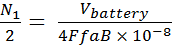
Number of turns

Using the basic transformer design equation:
basic transformer design equation

Primary turns (square-wave: F = 1, V - Vbattery)
basic transformer design equation
Primary turns (modified sine-wave: F = 1, V - Vbattery)
basic transformer design equation

basic transformer design equation

basic transformer design equation
Each half of the primary windings is
haft turns
Secondary turns N2
secondary turns

secondary turns

Switches

You may wonder why I keep referring those transistors as switches. Yeah they do exactly what switches do. They are MosFets, bipolar junction transistors (BJT) and thyristors (silicon control rectifier). Though thyristors can deliver very high current and are used for high power inverter, its switching circuitry is complex. MosFets and BJT are two switches that I have used in my designs, but mostly MosFets.  MosFets allow higher current than BJT. Unlike BJT which is current driven MosFet is voltage controlled, hence lesser power in the driver circuit.

The drain-source (MosFet) or collector-emitter (BJT) current is the effective current of the primary windings. Therefore transistor with drain-source or collector-emitter current far above the effective current should be chosen. In a case where the current is several hundreds of ampere and one cannot get a single transistor that can deliver this current, multiple transistors of the same type will be used. The transistors will be connected in parallel such that the current spread across them equally. For instance, if the current is 100ampere and the available transistor can deliver 30ampere, four or more of the transistor should be used. It is always advisable to use transistor with drain-source or collector-emitter far above the effective current in application like this.

Oscillator/driver

I intentionally put the two together as there is no much as far as design of inverter is concerned. The driver can actually be omitted if not needed. As I explained above driver is introduced when oscillator is not given us the required voltage level needed to drive Mosfets or current that is enough to fire the BJTs to deliver required collector-emitter current. It is nothing but an amplifier circuit.

Free multivibrator circuits are available online and in various electronic textbook that you can make use of. My preferred multivibrators are those ICs; what I did was surfing internet for data sheets of different multivibrator ICs. Of course all you need is in the data sheet only for you to make little adjustment/modification that will make it fits in to your design. What you need to do most of the time is to calculate frequency determining components of the circuit as it is presented in the data sheet.

Battery

The common battery used in inverter is a lead-acid battery of the type used in automobiles, sized to operate for few hours. Automotive batteries are often used because they are relatively inexpensive. Ideally, inverter should use deep cycle lead-acid batteries that have thicker plates and more electrolyte reserves than automotive batteries and allow for deep discharge without seriously reducing the life of the battery or causing damage to it. In a well designed inverter, deep cycle batteries can last up to ten years.

In a case where deep cycle battery is not available for use, truck batteries can be used. They have thicker plates than car batteries, almost of the same thickness as deep cycle batteries. This will extend the battery life in an inverter significantly compared to a car battery.

Battery size calculation and specification

Batteries are rated in ampere-hour (Ah) and the sizing depends on your need: on how long you want the inverter to work relative to the loads you place on it. The formula below gives you the required battery size.
battery sizing
Discharge capacity arise from the fact that one does not use complete battery capacity. Only certain percentage (discharge capacity) of the battery would be used. A deep-cycle battery can be discharged up to 80% (actual value depends on your low voltage disconnect) of its capacity.

Conclusion

All you need to design and build your own working power inverter has been discussed in this article. Nevertheless, there are some other features that are not mentioned in this article that can be added to your inverter. these include: charger and charger controller, low  voltage disconnect circuitry, overload/short circuit protector, high temperature shutdown and so on. All these will be discuss as we come across them in my inverter circuits.